
Back in 2019 we published a three-part series introducing and fleshing out our model of the competitive market segmentation of law firms.
We posited that the two primary segments of BigLaw are the “maroons,” go-to firms for bet-the-company matters garnering boardroom attention, where the cost of legal counsel is no real object, and “grays,” the rest of the legal industry taking care of matters that require attention but which are nowhere near existential for the clients. An example of a Maroon matter would be a hostile takeover bid or a gnarly shareholder derivative suit. An example of a Gray matter would be contract disputes with suppliers or vendors or spats over compensation and severance with departed executives.
We updated this model post-pandemic in 2023 in an article titled “The Next Chapter,” which primarily focused on the implications for firms of where they fit in a 2 x 2 market matrix we presented dividing both maroons and grays into those firms which were well run or managed and those which were not.
A quick recap of each sector and its strategic implications:
- Well-run maroons: Steady as she goes. Your only real threats would be self-inflicted, in the form of complacency or a relaxation of discipline.
- Poorly run maroons: Have you funded your retirement plan?
- Poorly run grays: As above, unless you have remarkably forgiving or inattentive clients
- Well-run (or “superb”) grays: Our favorite sector and the most fascinating. Sparsely populated but powerful and distinctive (generating demand-pull) if you can sustain it.
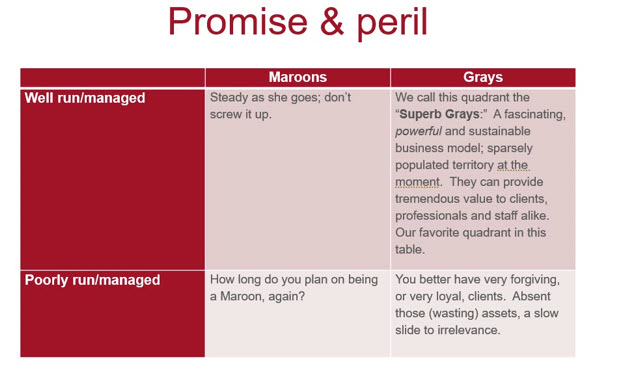
Maroons/Grays Matrix
It’s again time to revisit and update this model in light of the arrival of generative and agentic AI.
We actually foreshadowed this somewhat obliquely in our most recent column, Are You Smarter (at AI) Than Your Clients? It was our first foray into AI’s implications for the structure of the corporate legal services market and we made glancing reference to our hypothesis that AI could constitute a brand new, third, legal service provider in the market previously occupied exclusively by BigLaw and in-house corporate legal departments.
The introduction of agentic AI, and its capability to answer legal questions, adds a third source of supply to this model.
Let’s back up a second. In the classic Econ 101 supply/demand curve model, demand for legal services in the market relevant to readers of Adam Smith, Esq. is generated by corporations, and perhaps a few substantial nonprofits and wealthy individuals. Sources of supply are two: BigLaw and corporate in-house legal departments. How does the arrival of agentic AI change this market model?
Here’s the historic model.
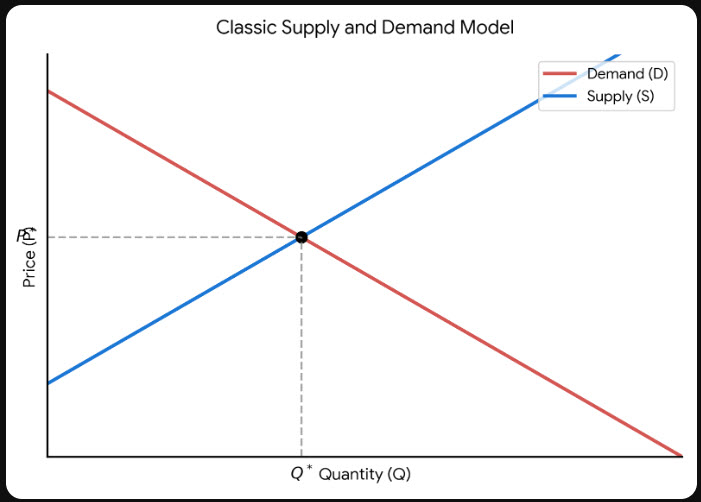
Image generated by Gemini
Now introduce agentic AI and what changes? It introduces a new supply curve at a lower price for the same quantity–the green supply curve below and parallel to the original blue supply curve.. (We assume for simplicity that demand does not change.)
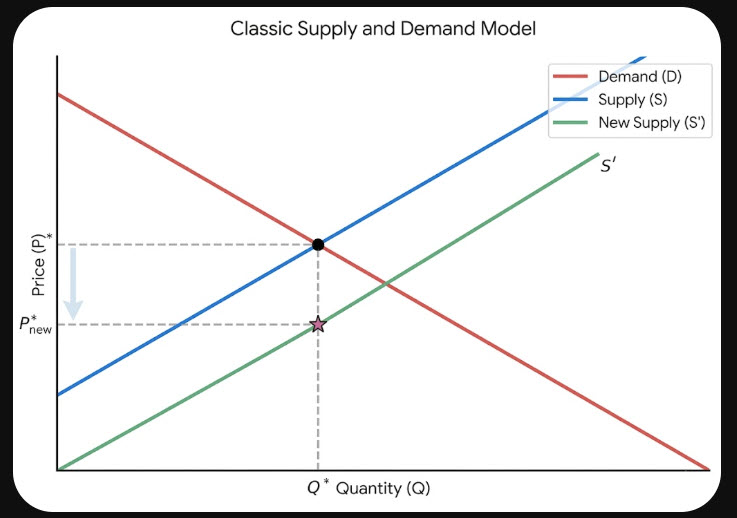
Image generated and updated by Gemini
The implications of this new market model depend on where you sit, as it were.
Corporate in-house departments win hands-down. They have their existing installed supply base of in-house lawyers and “captive” demand from the rest of the corporation. But now they also have agentic AI supply resources at far lower cost than human lawyers–not quite “too cheap to meter,” in the notorious phrase, but a powerfully attractive substitute for costly humans and, given appropriate hygiene about fact-checking and hallucinational AI responses, quick and reasonably comprehensive. (Moving forward in this column, let’s assume this hygiene will be SOP; in other words, we are not assuming conscious malpractice.)
The picture for law firms is nowhere near as simple.
For grays in the lower right quadrant of the market model presented above–and if they do nothing differently–I can only surmise that it accelerates their marginalization. GAI provides far faster, far far cheaper, and “good enough” legal advice.
The Superb Grays, top right, remain in our humble opinion, the most thought-provoking quadrant. They should be able to evolve their business model to continue to provide human-centric hand-holding and empathetic legal advice, but now undergirded by a much cheaper supply chain–GAI doing the baseline analysis plus smart, well-trained human lawyers dealing with clients directly.
As for the maroons?
I don’t see much of consequence changing. By definition, they serve the high-stakes, legal-fees-are-no-object, portion of the market. Sure, they should employ agentic AI internally to jump-start projects, get a dispassionate second opinion at times, and make sure the great WorldWide Web doesn’t feature blatantly contradictory credible material, but that’s about it. One caveat: The Presiding Partner of Cravath was conspicuously quoted in the legal media within the last week evincing surprising complacency when asked about losing a dozen or so high-profile partners just this year [paraphrasing]: “We’re happy where we are.” Does that strike you as inconsonant with being firmly in the top left quadrant?
Finally, here’s one final observation. Odds are no professionals in your firm at the moment are super-qualified to direct the lawyer/GAI relationship and interaction. Wouldn’t it be nice to have a few such people? Before your competition does?

Your new team leader? (Generated by Gemini AI)


Brilliant insights, as always. A dynamic time in the law world and Bruce guides us forward in support of our clients and the integration of innovation in our law firms.