
David Morley, former head of Allen & Overy and, happy disclosure, a long-time friend, just published an article over at law.com that starts like this:
The call usually comes on a Friday afternoon. A star partner has an offer from a rival: an eight-figure guarantee, maybe a leadership title, certainly a deadline. Match it, and you risk an escalating spiral of pay demands from existing partners. Refuse, and you may lose the partner, their team and the clients who leave with them.
Keeping frogs in a wheelbarrow: the free-agency era
This is the free-agency era in law, and it tops every elite firm’s agenda. Running a partnership has been likened to keeping frogs in a wheelbarrow. The sides have now come off. It is a pay war, but its roots are structural. […] Naked in, naked out.
Also out a week or so ago was a feature in the FT discussing the new reality that Citigroup, Goldman Sachs, and Morgan Stanley (and can others be far behind?) expect law firms’ cost savings from AI to be passed along in the form of lower fees:
“If the number of hours they’re working on a matter has come down because of AI?.?.?.?our expectation is for costs to come down significantly per transaction,” Adam Meshel, global head of legal at Citigroup.
These mega banks are lawyer-intensive, high-revenue clients–indeed, they’re about as sophisticated and demanding as they come. Consider their approach this year to the spectacular advances in generative and agentic AI to be par for the course among more mainstream clients a year hence. If so, the market share of the billable hour has peaked–as has BigLaw’s almost unlimited ability to charge high triple-digit hourly rates for countless hours of associate work.
Another, economic, dynamic is at work in the direction of devaluing associates: Indeed, “disintermediating” their role in what clients pay law firms for altogether. The introduction of agentic AI into the legal services supply chain constitutes an existential challenge to associates both from the bottom and from the top. From the bottom simply because agentic AI started by taking on relatively elementary tasks–read, what junior associates do–and from the top because the fewer associates a star rainmaker needs to close big deals, the more portable his book of business is. After all, clients pay that person’s breathtaking rates not for execution (associates) but for their ineffable perspective in the middle of negotiation and their judgment. (Whether or not you believe in the 10,000 hour rule–I think it’s a massive oversimplification–there’s deep human truth to the principle of learning by doing.)
As David Morley puts it, instinctively picking up on the tenor of a boardroom, intuiting what’s a bluff, maintaining a client’s trust in the face of adverse developments.
The “pre-AI” leverage/revenue model of BigLaw was impressively remunerative. Assume an associate is paid $400,000/year, all-in. At an hourly rate of $800 (the FT article says it’s $798) and annual billings of 2,000 hours, the firm has recovered its costs in three months–so from April 1 until year-end every hour billed is essentially pure profit, or a gross margin of 75%. OK, this isn’t quite software territory, where the marginal cost of an additional sale is zero, but for an industry with human beings’ labor at its core, not bad.
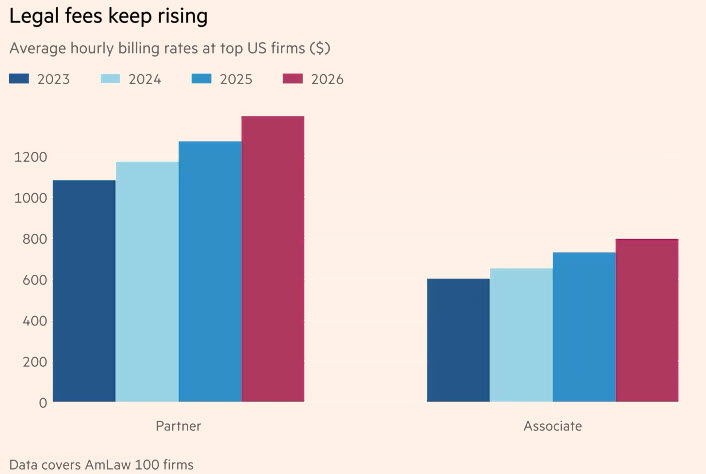
Source: FT article cited above
Another consequence of truly powerful AI is reallocation of legal work from outside law firms to large corporate inhouse law departments. The FT quotes Steven Croley, GC of Ford, as reporting that the automaker is already doing more legal work inhouse and hiring more lawyers, cutting demand for outside counsel. This converts a variable cost–unpredictable outside counsel hourly charges–to a fixed cost, which corporate CFO’s always prefer since they can then budget with no surprises.
If there are forces pushing in the other direction–a disproportionate share of work and headcount growth going to outside firms–the article mentions none and I can’t immediately think of any. (Sure, some law firms will always be growing at above-market rates as they astutely reallocate resources towards practice areas or geographies with above-market growth rates–we can stipulate same. But systemic industry-wide disproportionate growth in demand for firm lawyers over in-house lawyers? I’m not seeing it.)
If then firms are going to see their share of demand for legal services supplied by lawyers shrink, what about demand supplied by AI? All AI models “learn” by ingesting publicly available data, so there’s no room for competitive differentiation on that front. But here’s an opening for forward-thinking law firms prepared to make substantial investments in training their own proprietary AI using the dataset of their own proprietary “brief banks” and history of learning from thousands of corporate deals and negotiations. Harvey and Legora have access to and fundamentally depend on publicly available records, but no model has access to (say) Kirkland’s IP outside of Kirkland.
Again, here’s how Morley summarizes it:
The “firm brain” is a model trained on the firm’s own work: it captures what firms have never been able to codify, the reasoning inside the departing partner’s head. When every call is transcribed, every document indexed, every interaction recorded, the model can learn the reasoning behind the work, deploy it across the firm and hold it as a compounding asset.
As this new and unprecedented asset (“the ‘firm brain’”) begins to grow and become more extensive, more sophisticated, and more subtle, how should individual partners react? In early days, they should be delighted; it simplifies, automates, and accelerates access to one’s repository of IP accumulated over the years, without having to lift a pinky finger to tag, categorize, or bookmark any historic work product. The agentic AI does all that for you, automatically, continually, and invisibly.
But what if you hesitate to add your personal IP to this massive cloud of knowledge? What if you see around the corner and worry about what comes next: Because if/when I ever leave the firm, that IP will not be “mine” in the way it would have been in pre-AI days; it will belong to a law firm in which I have zero equity. You thought you were doing spectacularly to take home an outsized share of year-end firm profits, but the devil’s bargain for that was that you had to embrace a business model–so far, the only game in town–in which you do not and could not have any “equity.”
The fact that your title was that of “equity partner” is, long overdue, exposed as a blatant lie. The 98–99% of the for-profit economy that consists of businesses other than law firms uses the descriptor “equity” as God and Adam Smith intended it to be used, meaning a tangible, alienable ownership stake. By contrast, in Law Land, we have lived for more than a century with an unacknowledged but bald-faced contradiction around how we use the word “equity.”
Firms claim that client relationships belong to the firm. Partners claim those relationships belong to them as individuals. So which is it?
As I hope I implied, agentic AI throws this contradiction into the broad light of day, and I see no way of cleaving the disconnect short of changing the structural law firm business model and introducing a legally separate “division” of the firm next to the traditional Rule 5.4-mandated partnership of lawyers practicing law. That new division would be an incorporated MSO owned by businesspeople (presumably investors and strategic allies) and partners in the law firm.
What’s wrong with this analysis?

BigLaw Boardroom Looking at Past/Projected Lawyer Headcount

