
This is another installment in our series of profiles of leading economists from Capitalism and its Critics. It’s our first profiling not a champion of capitalist progress but a stout opponent.
Cassidy opens this, Chapter 3 of his work (“The Logic of the Luddites”) rather dramatically:
In the early hours of April 12th 1812 more than 100 men approached Lawful’s mill, a four-story building on the banks of the River Spen at Liversedge in West Yorkshire. This is Bronte country–a landscape of bleak moors, steep valleys, and small towns and hamlets. The members of the crowd, who had gathered on the moor hours earlier, were armed with muskets, sticks, hatchets, and heavy blacksmiths hammers. When they reached the mill, the men at the front broke windows in an effort to gain entry. Some of them fired shots into the dark factory. Unbeknownst to the attackers, the mill’s owner, William Cartwright, had been preparing for trouble
The background to this dramatic industrial-relations event was that a tight-knit group of skilled workers known as “croppers” had carried out the ancient art of dressing woven woolen cloth, which required raising the nap and cutting it into finished pieces. Cartwright was trying to replace these workers with new machines which used metal rollers to raise the nap and shearing frames operated by a single millhand turning a crank..
Exactly where the name “Luddites” came from is lost to history but a plausible theory is that it traces back to an Anglo-Saxon monarch who died in battle in AD 827 named King Ludica. The machine breakers identified themselves as under the leadership of General Ludd or Captain Ludd.
Either way, it’s important to understand that it was not a revolution. It was a defensive reaction to a new economic system that was threatening the livelihoods of many skilled workers. Rather than overthrow the system, Luddites were trying to preserve their place in it.
For context, realize how prominent and substantial a place industrial production occupied in Britain’s economy at the time. The eminent French free market economist Jean-Baptiste Say traveled around Britain shortly after the Napoleonic Wars and wrote in an 1815 account:
It is not the military power of England, nor even that of her navy, which has given her a preponderating influence on the Continent, nor can it be said that it is her gold; for since 1797 she has had nothing but a paper money…It is her wealth and her credit that have enabled her to exert this influence.
These technological advances were the result of competition and profit-seeking. Entrepreneurs like Cartwright were on the lookout for and open to new machinery and production methods, as these were a business imperative. The only limits were the pace at which science and technology progressed and, as we have noted, the opposition of workers feeling threatened.
You probably have connected the dots already, but to lay our cards face up: Doesn’t this remind you of ABA Model Rules of Professional Conduct §5.4 and the “unauthorized” practice of law?
But let’s move along.
Economic rationality and profit maximization are only one part of the story; the immiseration of the croppers and weavers, in an era where the concept, much less the reality, of a social safety net was inconceivable, brought devastating human consequences. Wages for croppers and weavers fell 60% from 1800 to 1820–if there was work to be found at all. One eyewitness “found on one side of the fire a very old man, apparently dying, on the other side a young man about eighteen with a child on his knee, whose mother had just died and been buried.”
History books commonly portray the Luddite movement as primarily or exclusively a struggle between incumbency and mechanization, and only incidentally mention the social impact of technological progress. But in The Making of the English Working Class (New York: Vintage, 1966, at 531-33) E.P. Thompson points out that the stakes weren’t limited to workers’ opposition to new machinery but entailed “the freedom of the capitalist to destroy the customs of the trade whether by new machinery, by the factory-system, or by unrestricted competition, beating down wages, undercutting his rivals, and undermining standards of craftsmanship.”
Again, these are not issues of productivity or profit margin. The Luddites were not making a valiant stand against a new economic structure per se: Their position was bottomed on whether one party could unilaterally violate a long-established set of social values and reciprocal obligations. As I said:
[They] saw laissez-faire not as freedom, but as ‘foul Imposition. They could see no ‘natural law’ by which one man, or a few men, could engage in practices which brought manifest injury to their fellows.’
If this sounds abstract to you, far distant in time, economic context, and professional vs. industrial context, “ask not for whom the bell tolls.”
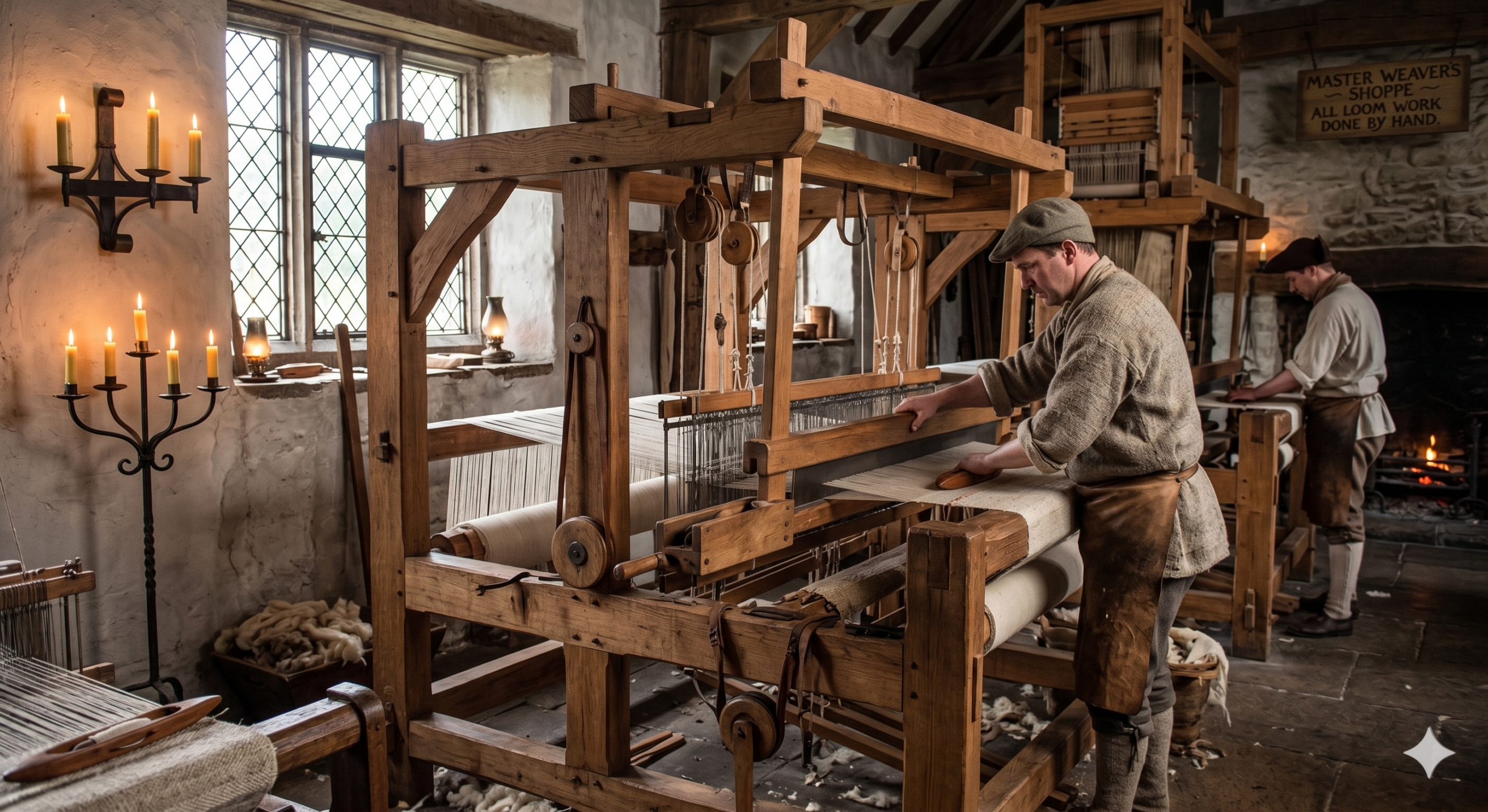
Textile Mill ca. 1810 (Image courtesy Google Gemini)

