
Continuing our series on prominent economists from the Industrial Revolution to AI, drawing liberally on the impressive accomplishment of John Cassidy’s Capitalism and its Critics: A History: From the Industrial Revolution to AI (John Cassidy, Farrar, Strauss and Giroux: New York [2025]), we come to his chapter “Parsing Globalization,” profiling Stiglitz and the less well known but equally intellectually gifted Samir Amin and Dani Rodrik.[1]
Consonant with the Chapter’s title, it opens with what seems an emphatic albeit symbolic dance on the grave of Communism:
In July 1993 a new open-air museum opened on the southern outskirts of Budapest. Memento Park featured dozens of Communist-era monuments that had been put in storage a few years earlier when Hungary ended decides of one-party rule. Among them were a bronze statues of Vladimir Lenin, which had long stood in the city center and granite statues of Karl Marx and Friedrich Engels, which had loomed over the entrance to the Hungarian Communist Party’s headquarters, creating what was effectively a Communist theme park, Budapest’s city council wasn’t honoring the patron saints of Marxist-Leninism: It was trying to stimulate the local economy. “It is more interesting for tourists than for Hungarians” Mayor Gabor Denszjt explained, “We want it to become an international attraction.”[2]
This sets the stage for the theme of the chapter, which is one of disequilibrium as capitalist theory and practice triumph in one area only to over-reach and provoke a counterreaction. This exemplifies the pattern:
A century and a half after the publication of The Communist Manifesto, the representatives of international capital really were nestling everywhere and remaking the world in their likeness. The process of global integration appeared to be unstoppable. Between 1985 and 1995, the overall volume of international trade nearly doubled, and the daily value of foreign exchange transactions rose more than eightfold.[3]
Interestingly,, and perhaps unconventionally Cassidy does not lay these changes at the feet of communism being ideologically discredited. He points to technological and economic innovations, including shipping containerization (!—who knew a seemingly lowly technological advance could have geopolitical consequences) and the rise of IT and more specifically vastly cheaper telecommunications technology. (This enabled data about supply, demand, pricing, factors of production, market maturity, and so on to be exchanged efficiently and in near-real time.) But it took time for human analysis and understanding to catch up with the implications of these advances. As Cassidy puts it, trade economists emphasized economic gains from comparative advantages, labor economists wage stagnation and how to escape from it, macroeconomists a new era of price stability, and so on.
But there was no doubt where the prevailing winds were blowing. A short and sweet phrase distilling this movement was “the Washington Consensus,” coined in 1989 by John Williamson, a senior fellow at the Institute for International Economics. It soon came to be understood as embracing the structural assumptions of balanced budgets, tax cuts and government spending cuts, and eliminating tolls and tariffs on trade.
The initially invisible crack in this neat structure was that there was no political framework that included international markets. In other words, globalization could work fine until it didn’t—and then there was no ideological justification which could come to its defense: There never had been.
Exacerbating the depths and the consequences of the as-yet unexposed fissures were that while overall employment would increase with the expansion of free trade—markets would expand, efficiency would rise, and overall global welfare would increase—trade created losers, not just winners. And a key cohort of losers were US workers who theretofore had been creating products that now faced competition from Chinese-made alternatives and substitutes, typically of equal (or satisfactory) quality and at dramatically lower prices.
Then, in 1997, the first major blowup of hyper globalization erupted first in Thailand but spread quickly to South Korea, Singapore, and Indonesia. Recessions became the order of the day, stock markets and local currencies plunged, and the same countries that had been poster children for economic growth and innovation suddenly were forced to go the IMF asking for emergency relief.
But the IMF pulled out its old playbook and demanded budget cuts and austerity and higher interest rates. Matters got worse. Understandably, with bankruptcies and unemployment rising fast, the IMF faced a backlash.
And here Stiglitz re-enters the picture: He agreed with the leaders of the stricken economies. In 2002 he published Globalization and its Discontents, which argued that overly rapid liberalization of capital markets was behind the downturn and, worse, was indifferent to the plight of those in the suffering economies. Stiglitz:
“a few institutions—the World Bank, the IMF, the WTO—and a few players—the finance, commerce and trade ministries, closely linked to certain financial and commercial interests—dominate the scene, but many of those affect by their decisions are left almost voiceless.”
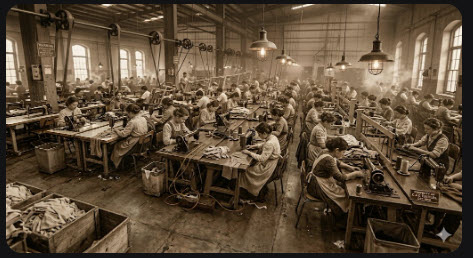
Not only the Western powers but, at least initially, the leaders of the developing economies themselves, displayed callous and even borderline criminal indifference to the conditions under which impoverished workers labored. Nearly a century after New York’s notorious Triangle Shirtwaist Factory Fire of 1911, which took the lives of 146 women, in 1993 a fire at a toy factory outside Bangkok killed at least 188 people (and likely many more as not all the workers were accounted for).
Even the cruelest details were reprised: Locked exit doors, narrow stairways that collapsed, desperate human beings jumping from 3rd and 4th floor windows—and blame placed squarely in the lap of brand-name Western companies including Toys “R” Us, Fisher Price, Hasbro, and JCPenney, seeking the most economical supplier of Muppets, Bugs Bunny, and Big Bird.
Back to the dynamics of Capitalism on a global scale. So where does all this leave us?
Cassidy supplies the conclusion:[4]
Even though the shock of the Global Financial Crisis had discredited free market fundamentalism, the subsequent stabilization of the financial markets and the unwillingness of the United States and other powerful countries to countenance major changes ensured that Amin’s “wild ride” of globalization would continue. And so would the political reaction against it.
Courtesy Gemini 3
[1] Amin (1931—2018) was a French Egyptian economist who spent some of his early years as a member of the French Communist party and subscribed to Maoism.
Rodrik (1957– ) is a Ford Foundation professor at the John F. Kennedy School of Government at Harvard. His research and writing have focused on what constitutes sound and effective economic policy and why not all governments are equally successful at adopting it. His BA is from Harvard and his MA and Ph.D. from Princeton.
[2] Capitalism at 458.
[3] Id. At 459.
[4] Id. At 479.

