
May I welcome you to the first of a few Adam Smith, Esq. portraits of notable economists? My source for all in this series is the redoubtable Capitalism and its Critics: A History: From the Industrial Revolution to AI (John Cassidy, Farrar, Strauss and Giroux: New York [2025]).[1] (Cassidy is a staff writer for The New Yorker and one of his two previous books was a finalist for the Pulitzer Prize in nonfiction. He is based in New York.)
Today’s book and the basis for this series is an intellectually solid and, to me at least, engrossing 28 chapters, each on a notable individual, or occasionally, movement (the Luddites, e.g.) recounting the history of capitalism from the 1600’s to today. To give you a flavor for it, a sampling of the people and institutions profiled include the East India Company, the Universal Workers’ Union, Rosa Luxemburg, Marx and Engels, Keynes, Milton Friedman, Henry George, and, well, you get the idea. While I recommend it enthusiastically and without reservation, potential reader beware: It’s comfortably over 500 pages and not exactly bedtime reading.
In any event, today we’ll try to encapsulate Veblen’s contribution. Without question his most enduring contribution to this field was his 1899 book Theory of the Leisure Class, whence we find such durable concepts/phrases as “conspicuous consumption,” and the “leisure class” itself. In what follows I’ll borrow extensively from Capitalism and its Critics in an effort to encapsulate Veblen’s thinking and his place in and contribution to economic theory and history.
One of Veblen’s earliest initiatives in the development of his theory was to attack head on the established theory of a rational homo economicus. He called this a “lightning calculator of pleasures and pains, someone who oscillates like a homogeneous globule of happiness under the impulse of stimuli that shift him about the area but leave him intact.” Veblen flatly disagreed. People aren’t just raw bundles of desires, but their behavior is motivated by propensities and habits formed from past experience, and current pecuniary circumstances.
But this sets the stage for a zero-sum game, or to be more precise, a game where the goal posts keep moving back. As Veblen puts it, for members of the leisure class “to rank high in the comparison with the rest of the community in point of pecuniary strength,” no amount of wealth, however impressive, could satiate the desire for more. At the extreme, indulging in “conspicuous leisure” might be the most impressive display of all; it demonstrates that one has liberated oneself from productive work altogether.
But let’s return to why we have inaugurated this series with Veblen to begin with. As Cassidy puts it, “The theory of conspicuous consumption is what he is most famous for, and with good reason.” Spending that Veblen would have classed as wasteful makes up an ever larger proportion of overall consumer spending.
Veblen divided the economy into two sectors: industry and business. The leaders of the first sector, the industrial class, were engaged in the task of making things and developing innovative new products and manufacturing processes. By contrast, “the business class, or pecuniary class, was composed of absentee factory owners, passive shareholders, financiers, and other owners of capital who were engaged merely in making money, or rather, in appropriating it from the productive classes. Their office is of a parasitic character.”
You may be thinking at this point that this is something we all know, but “the novelty of Veblen’s treatment of monopolization was that he framed it as a natural evolution of industrial capitalism rather than as an aberration. ” He also argued that charging a premium price was undergirded by advertising and the creation of an aura of prestige. Resources spent on developing these characteristics “do not add to the serviceability of the output, except it be incidentally and unintentionally.. It is useful to the seller, but has no utility to the buyer.” A Tiffany, Cartier, Rolex—or Patek Phillipe!—watch tells the time as accurately and reliably as one from Walmart, but no one would seriously maintain that they are interchangeable.
Finance also takes a hit. Veblen rightly recalls that when Adam Smith used the term “capital” he was referring to hard assets. machinery and raw materials, but by Veblen’s time, going forward to today, it has come to mean intangible financial instruments, stocks and bonds and derivatives and so forth, whose value depends on the opinion and fashion of financial markets.
You thought you were reading an ongoing analysis of the economics of Law Land? Yes, you are; let’s connect the dots.
Do you see the same analogy that I do? The reputation and prestige of the name brand elite law firms engaged for high stakes, “bet the company” transactional and litigation engagements are the Tiffany’s and Cartier’s of our world, occupying those extremely privileged positions in the marketplace where price is almost no object.
When clients hire such firms they are signaling to any and all that they have assessed the situation and are committing to conspicuous consumption. The message to their counterparty or adversary (and to everyone else in those positions down the road) is that we take these things very seriously; we’re not going to be pushed around. Want to take us on? Be prepared to inflict breathtaking expense on your client. In the real world, extrapolating from that of Veblenesque theorizing, “signaling” may be primarily what you need to do.
In other words, send the clear message to your counterparty that you’re willing to spend whatever it takes to maximize your odds of prevailing. You may never have to actually pay for scorched-earth representation. Think of it as a psychological analogue to the In terrorem effect.
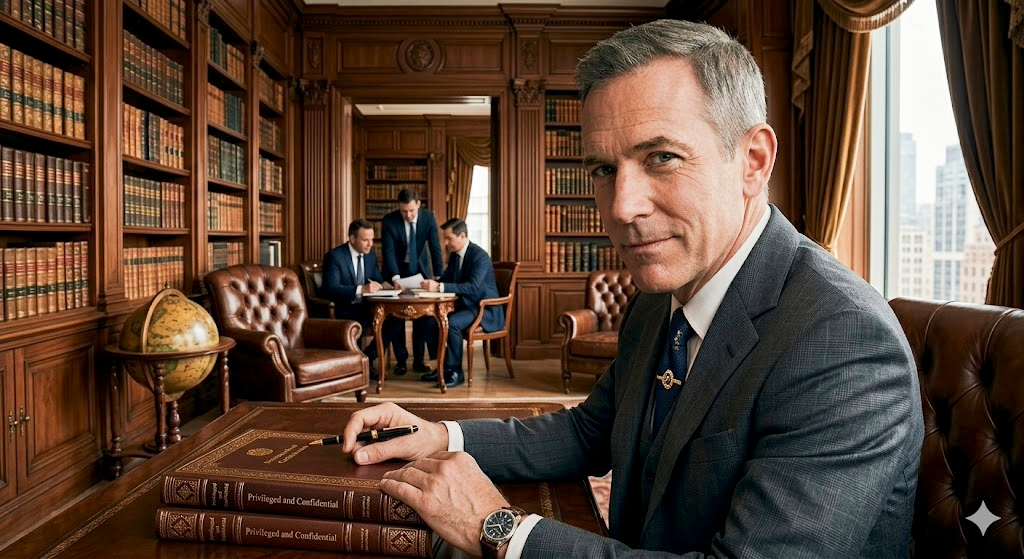
“If you have to ask, you can’t afford it.” Image courtesy Google Gemini.

