
Industries tend to follow quasi-biological life cycles of birth (invention/creation), childhood (halting steps), adolescence (self-discovery), rapid acceleration into maturity and supremely competent adulthood (what in ecology would be called the “climax phase”) and, yes, senescence and decline.
In terms of Law Land, a rough analogy is that Paul Cravath’s invention of his System a century or so ago represented our passage beyond childhood into adolescence, and that it’s all been one long, extended, increasingly glorious adulthood ever since, as we’ve refined and tweaked and buffed the model around the edges, making no material changes. And boy, did it ever deliver the goods, in terms of BigLaw growing as a share of GDP and PPP growing in relation to the average worker’s earnings. And it worked for virtually everyone who’d climbed aboard the bus, whether they were terribly introspective and astute about what they were doing or not. Until about 2008, that is.
Now we’re in a transition phase, I believe, where a tremendous premium will be placed on firms’ ability to figure out their rightful place in this world, and clear blue water will begin to appear between firms who go on to ever greater strength and those who find themselves relatively marginalized and, yes, irrelevant.
We are scarcely the first, nor will we be the last, industry to go through this life cycle.
Indeed, this life cycle is so well-known that it has been diagrammed, and it’s called the “S-Curve.” Here it is:
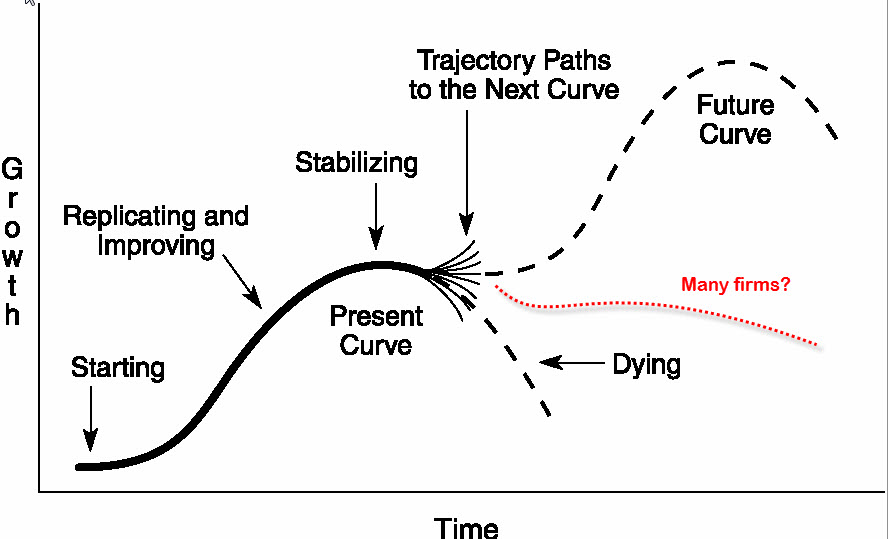
(Image courtesy CEO ThinkTank.)
I submit we may be approaching the fraying ends of the “Present Curve,” where the “Next Curve” is indistinctly and dimly not quite yet in focus.
What determines the speed with which clients adopt the “next curve?” Three primary factors, none of which bodes well for those wedded to the status quo:
- Relative superiority: How much better is the new than the old? Many clients seem to think the old is not great.
- Complexity vs. simplicity: Is the new difficult to use or adopt? Given that clients are largely driving it, I’d have to guess not.
- Awareness: If no one has ever heard of the “next thing,” good luck with it. Everyone has heard of LPO’s, alternative fees, etc.
To be clear: I do not envision this as the phase-jump from circuit boards to microchips, analog to digital, or CRT to flat-panel, where the original incumbent was supplanted in its entirety. No. Law firms as we know them are not going away.
Rather, I see this as a jump from a world where merely to be a conventional law firm was to live at the climax stage of the “Present Curve,” into a world where performance of some firms will vault onto the “Future Curve,” while that of others (most?) will follow the irresolute trajectory I’ve depicted with the red dotted line.


Not sure what the online equivalent of giving a speech a standing ovation, but that’s the feeling I wish to convey at the end of this series. Superb.
And I’m not sure what the online equivalent of toasting you for that kind remark is, but that’s the feeling I have at the moment! Sincerest thanks.
Bruce,
I read all 12 installments of your series with great interest….twice. This is an extraordinary body of work that reflects enormous insight and ought be required reading by every managing partner of every law firm, or professional services organization, in the world. You do a very effective job of challenging the status quo and your series is something between a call to arms and a much-needed wake up call for our profession. As always, I plan to share many of your insights with my partners. And I plan to cogitate over many of your proposed initiatives.
Brad
Brad:
As always, your thoughts are deeply appreciated. Your comments are frankly quite touching.
I’m quite passionate about these things so very glad, and ever so slightly relieved, to know others pick up on that.
All the best,
Bruce
(Editorial note: Brad Karp is the Chair of the Firm at Paul Weiss.)
Great read. I feel the transformation of the status quo begins in law school. There are groups of law students that acknowledge the industry’s course must change. These students desire to work for and start firms that embrace “change.” However, connecting with these types of firms is another challenge entirely, because even mentioning this “legal renaissance” immediately puts you on a type of interview black list–for most firms.