
For those of you who may have missed it, we refer you forthwith to Brian Dalton’s latest column on Above The Law, “Is There a Business Case for More Female BigLaw Partners?” Anyone with a scintilla of conscience can only look at the information presented there with some combination of shame and dismay—if not despair.
A few quick highlights and then our own take on the situation. (Disclosure: Brian is a friend and we had an early peek at the data underlying his article.)
- The ratio of male:female law school graduates has been all but equal for at least the past 30 years. (The NALP figures for the Class of 2012 are here, showing a 47% female: 53% male ratio.)
- Yet for as long as most of you practicing today have been around, the AmLaw 200 has averaged around 17% female partners—that’s about one in six.
- Anyone and everyone looking at this situation has reached the conclusion, as Brian puts it, that “if the legal profession — specifically law firms — is truly trying to foster the advancement of women attorneys, we can all stipulate that the effort is thus far a failure.”
Comes now the National Association of Women Lawyers with a breathtaking chart on the gender distribution by law firm role, and it’s two straight lines with opposite slopes showing the lower-ranked and lower-paid the position in a law firm, the more women are there:
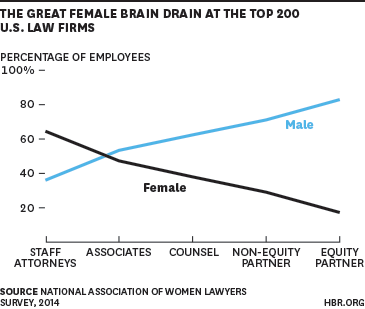
[Note: Both the HBR article that reprints this NAWL finding and the Above the Law piece note incorrectly that “every year, top law firms recruit 60% female and 40% male law graduates.” That’s not the case; they recruit roughly 50/50. It’s the staff attorneys whose ranks are >60% female and <40% male. This correction only makes the news worse, of course, since {partner-track} associates are higher on the prestige food chain than staff attorneys. The correlation between male/higher prestige and female/lower prestige is only reinforced.]
One reason I’ve written so infrequently about diversity and gender imbalance issues here at Adam Smith, Esq. (an intentional decision, since you ask) is that there has seemed so distressingly little of cogence to say on the subject beyond lamenting the blistering inequity of it. I also find sermonizing unbecoming.


Two thoughts:
1) If there are equally qualified women and men, in equal proportions, then wouldn’t it be the case that by going deeper into the pool of men than women to promote partners, firms are getting somewhat less qualified men than the women they could have had? Now, of course, there are many characteristics that determine qualification, and perhaps the differences are insufficient to translate into large differences in money, but all things being equal, it seems that some women don’t make partner despite being more qualified than the men who do. If you look at the chart, with Wilmer having the most female partners, it’s still nowhere near 50%. Would you expect a tipping point at some percentage of women partners that produces larger changes, as opposed to a linear relationship?
2) Your conclusions about what hold women back are common, but by no means the whole story, and in my experience aren’t necessarily the most prevalent or important issues. For example, men are judged on their potential while women are judged on what they have done. When it comes to rainmaking ability for partnership decisions, men have an edge if all they need is potential. Women are expected to prove themselves over and over while men only need do so once, which is frustrating to the women. A “go-getter” attitude is appreciated in younger associates, but by the time women are at their 5th or 6th year, that attitude is considered aggressive, sharp-elbowed, and the sign of someone who is not a team player. Women are taken off cases when they become pregnant and have trouble getting work when they return from leave, which I have heard male partners say is because those women will probably just stay home with the kid anyway. But the result is they can’t meet their hours and thus won’t get bonuses or promotions. Even in this day and age, sexual harassment is rampant and plenty firms work to quell the outcry rather than address the problem.
The solution, of course, is to have women partners who are viewed as supremely competent, because then no one will question that women can do all the things men can do.